A Comprehensive Guide to the Northern Lights in Iceland
Iceland is one of the best places in the world to see the Aurora Borealis, and the reasons go beyond just latitude. The forecasting tools are good, dark skies are easy to reach, and the landscapes give you something worth seeing even on a cloudy night.
This guide covers everything: the science, the best times and places, how to read a forecast, tours vs. renting a car, photography, a full itinerary, and the most common questions.
Key Takeaways
- Iceland is one of the easiest places in the world to see the Northern Lights thanks to its location under the auroral oval, long winter nights, and dark skies that are easy to reach from Reykjavík.
- Clear skies matter more than a high Kp number. In Iceland, a Kp 2–3 forecast is often enough for a solid aurora display if the clouds stay away.
- October, February, and March are usually the best months to visit because they give you a good mix of darkness, manageable weather, and decent road conditions.
- Jökulsárlón Glacier Lagoon, Vík, Snæfellsnes Peninsula, and Þingvellir are some of the best places to watch the aurora because they combine dark skies with incredible scenery for photos.
- Renting a car gives you the most flexibility for chasing clear skies, but winter driving in Iceland can be rough due to black ice, strong winds, and sudden storms.
- Good aurora photos are mostly about preparation, not expensive gear. A tripod, manual camera settings, and strong foregrounds like waterfalls, glaciers, or black sand beaches make the biggest difference.
What Are the Northern Lights?
Before anything else, it helps to understand what you're actually looking at. The science is simple and makes the whole experience more interesting.
The Science Behind the Aurora Borealis
The Northern Lights happen because the Sun constantly sends out a stream of charged particles called solar wind. When those particles reach Earth, our planet's magnetic field deflects most of them. Near the poles, though, the field funnels some particles down into the upper atmosphere. When they collide with oxygen and nitrogen atoms up there, those atoms release energy in the form of visible light.
The color you see depends on which gas is involved and at what altitude:
- Green is by far the most common, produced by oxygen at around 100–300 km altitude
- Red comes from oxygen higher up, usually during strong geomagnetic storms
- Purple and blue tones come from nitrogen
- Pink edges appear during intense displays at lower altitudes
How dramatic the show gets depends on solar activity. Solar flares and coronal mass ejections (CMEs) push large amounts of charged particles toward Earth, which trigger geomagnetic storms. Those storms produce the strongest auroras. Iceland sits right under the auroral oval, so even moderate solar activity can put on a decent show.
The aurora shifts and pulses because the solar wind and Earth's magnetic field are constantly changing. A quiet arc can blow up into a full-sky display in just a few minutes, so don't give up if things start slow."]

Section Recap
| Topic | Key fact |
| Cause | Charged particles from solar wind collide with oxygen and nitrogen in the upper atmosphere |
| Green color | Oxygen at 100–300 km altitude |
| Red color | Oxygen at higher altitudes, during strong geomagnetic storms |
| Purple/blue | Nitrogen |
| What drives intensity | Solar flares and coronal mass ejections (CMEs) triggering geomagnetic storms |
| Why Iceland works | Sits directly under the auroral oval |
Why Iceland Is Perfect for Aurora Viewing
Norway, Finland, Canada, and Alaska all sit at similar latitudes. So why do so many people pick Iceland? Because it's unusually easy to actually do it there.
Location, Darkness, and Getting Around
Iceland sits close enough to the auroral zone that a Kp 2–3 event — which is pretty common — can produce a visible display on a clear night. From September through April, you get long nights. In December, that's up to 18–20 hours of darkness, which gives you a huge window to work with.
You also don't have to travel far from Reykjavík to find genuinely dark skies. Within 30–60 minutes of the city, you're in open lava fields, along coastlines, or near glaciers, with light pollution mostly gone.
The Landscapes Make Everything Better
This is what really separates Iceland from other aurora destinations. Tromsø in Norway has great dark skies, but Iceland gives you volcanoes, black sand beaches, glacier lagoons, geysers, and waterfalls all in one compact road trip. Even on nights when the forecast is bad, you're somewhere interesting. That makes the trip worth it regardless.
The Forecasting Tools Are Actually Useful
The Icelandic Meteorological Office has an aurora forecast that shows both cloud cover and auroral activity on a 0–9 scale. On the map, white areas are clearer skies and green areas are cloudier. It updates regularly and is easy to understand. I'd recommend checking it every evening before you decide where to drive.
Norway (especially Tromsø) is excellent, and Finland's glass cabin experience is genuinely cool. But Iceland wins for variety: glaciers, volcanoes, beaches, waterfalls all on one road trip. For a first-time aurora traveler, Iceland is the most well-rounded option."]
Section Recap
| Factor | Iceland's Advantage |
| Latitude | Close to the auroral oval; Kp 2–3 can produce visible displays |
| Darkness | Up to 18–20 hours in December |
| Dark sky access | 30–60 min drive from Reykjavík |
| Landscape variety | Glaciers, volcanoes, beaches, and waterfalls on one road trip |
| Forecasting | Icelandic Met Office combines cloud cover and aurora activity on one map |
| vs. Norway | Iceland wins on landscape variety and road-trip flexibility |
| vs. Finland | Finland has glass cabins; Iceland has more diverse scenery |
Best Time To See the Northern Lights in Iceland
September to April is the season. But which month you pick matters more than most people realize.
Aurora Season Month by Month
The Midnight Sun makes summer sightings basically impossible; the sky stays too bright to see the aurora. Once September arrives and real darkness comes back, you're in business. Here's how the months break down:
- September: Shorter nights, but milder weather, better road conditions, and equinox periods that can boost geomagnetic activity. Good for combining aurora trips with daytime sightseeing.
- October: Noticeably darker nights, and roads are still mostly fine. One of the best all-around months.
- November–January: Maximum darkness near the winter solstice, but also the coldest, stormiest period. Road closures happen more. December has the longest nights but also the highest prices.
- February: Still plenty of darkness, and daylight is slowly returning. Aurora activity can be strong, and the winter scenery is at its best.
- March: Often the sweet spot. The equinox period can trigger stronger geomagnetic storms, days are getting long enough for real sightseeing, and roads are generally in good shape.
- April: Still possible early in the month, but the nights are shrinking fast.
If I were planning this trip, I'd aim for October, February, or March. You get enough darkness without dealing with the full force of an Icelandic winter.
Best Time of Night
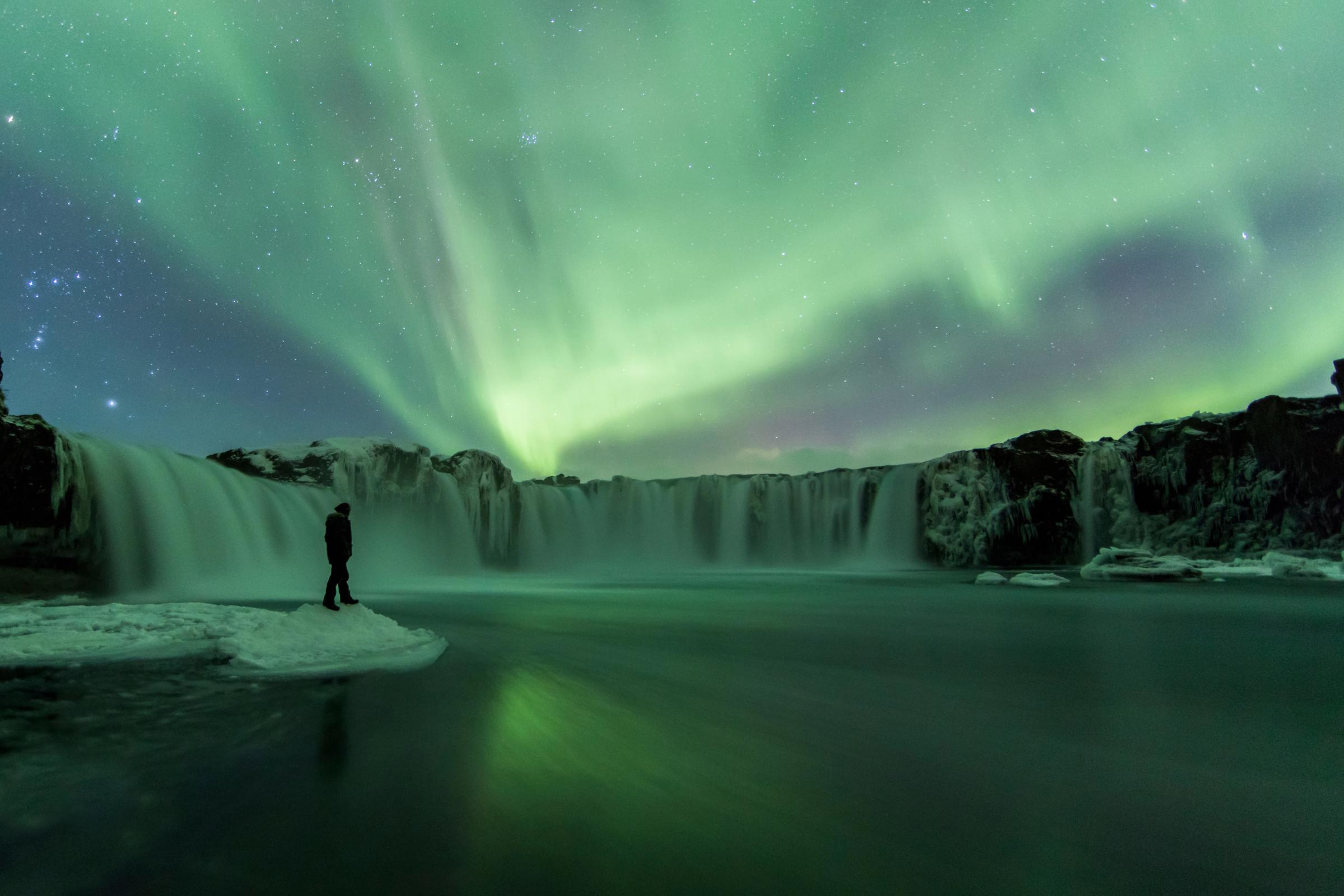
Most displays are strongest between 9 PM and 2 AM, peaking around local midnight. That said, if solar activity is high, auroras can appear earlier or later.
Moon Phase
A full moon reduces contrast and makes faint auroras harder to pick out. A new moon gives you the darkest sky. That said, don't skip a hunt just because of a bright moon. Strong auroras will still show up, and moonlight can actually light up the landscape nicely for photos.
The four things you actually need to see the Northern Lights: darkness, clear skies, aurora activity (Kp index), and low light pollution. Clear skies are the most important of the four. A massive geomagnetic storm behind clouds is completely invisible."]
Section Recap
| Month | Aurora Potential | Best For | Watch Out For |
| September | Good | Mild weather, equinox activity | Shorter nights |
| October | Very good | Balance of darkness and accessibility | Increasing storms |
| November | Excellent | Long nights | Cold, stormy, wetter |
| December | Excellent | Maximum darkness | High prices, severe weather |
| January | Excellent | Deep winter scenery | Road closures, harsh conditions |
| February | Very good | Darkness + improving daylight | Still full winter |
| March | Excellent | Equinox boost, good roads | Popular, busier |
| April | Moderate | Late-season option | Nights shrinking fast |
| Best viewing window | 9 PM–2 AM | Around midnight | Varies by month |
| Moon phase | New moon best | Darker skies | Full moon reduces contrast |
Best Places in Iceland To See the Northern Lights
No location in Iceland guarantees a sighting, clouds decide that. But some spots combine dark skies with genuinely great scenery, which makes them worth prioritizing.
Reykjavík
You can see the Northern Lights from Reykjavík during a strong display, but the city's light pollution kills faint auroras. Think of Reykjavík as a base, not a viewing spot.
Best Spots Near Reykjavík
- Grótta Lighthouse (Seltjarnarnes): The easiest option for travelers without a car. It's not truly dark, but it faces north over the bay and is walkable from downtown.
- Reykjanes Peninsula: About 30–40 minutes from the city, you hit lava fields and coastlines with much darker skies. A solid, quick option.
If you're staying in Reykjavík and don't want to drive, I'd recommend booking a guided tour rather than hanging around the city hoping for a strong enough display.

Þingvellir National Park
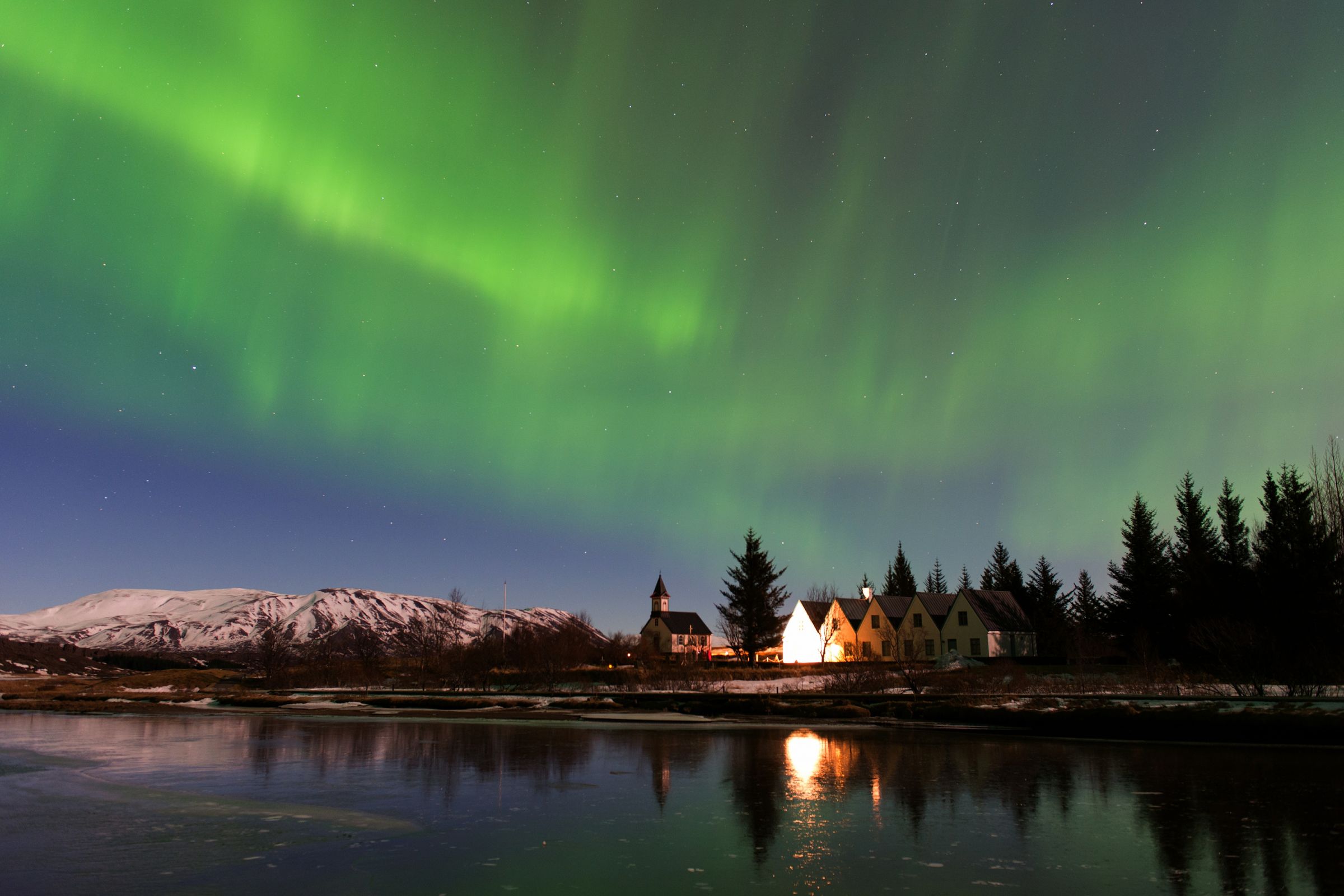
About 45 minutes from Reykjavík, Þingvellir is a UNESCO World Heritage Site sitting on the boundary between the North American and Eurasian tectonic plates. It's one of the most popular aurora spots within the Golden Circle for good reason: open landscapes, minimal light pollution, and easy access.
Vík & Reynisfjara Black Sand Beach
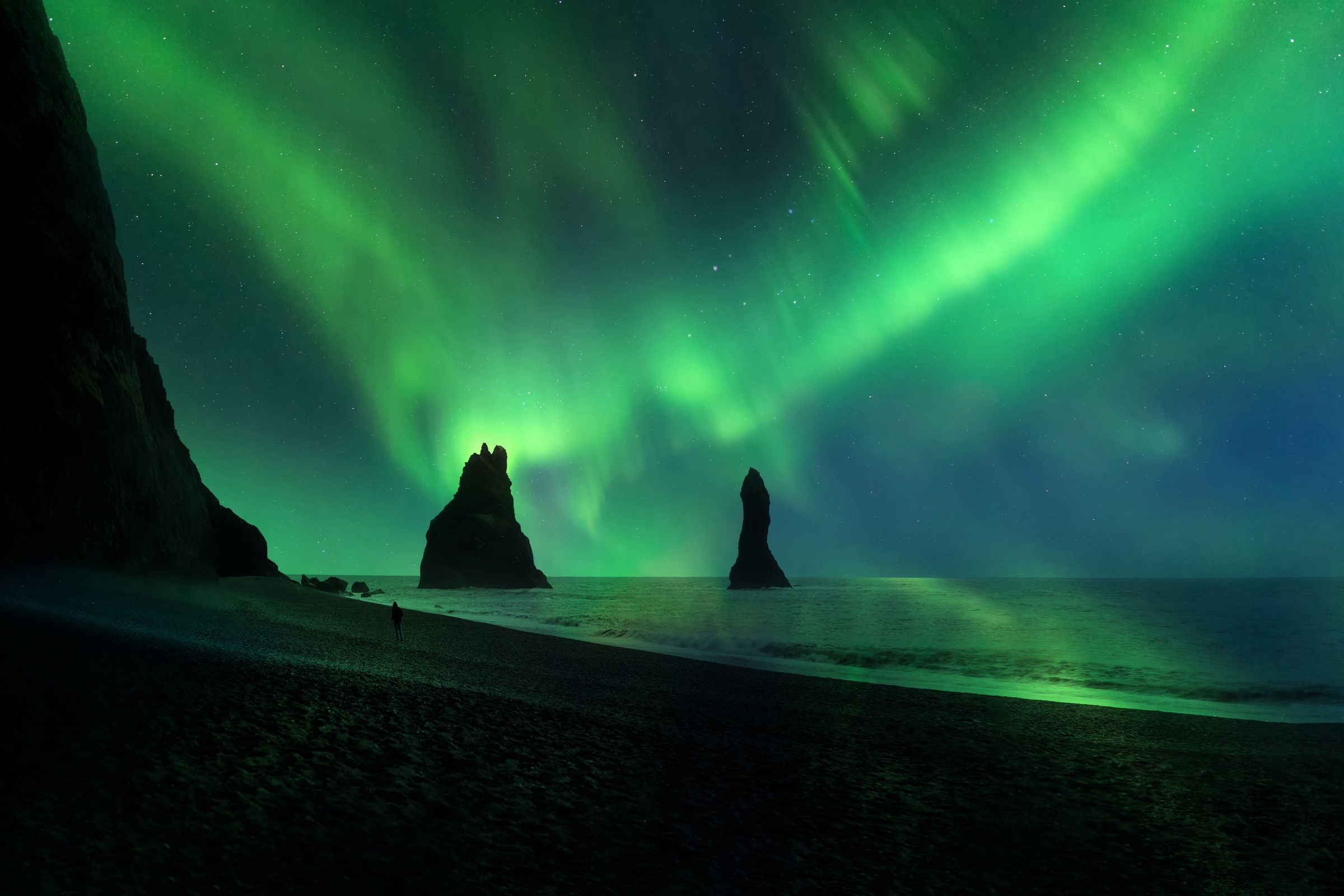
The South Coast has some of the best dark-sky scenery in Iceland. Reynisfjara black sand beach, with its basalt sea stacks and dramatic cliffs, is one of the more photogenic spots in the country for aurora photography.
One thing worth mentioning clearly: Reynisfjara has genuinely dangerous sneaker waves. Don't walk close to the waterline at night. Stay well back on the beach, especially in winter when it's dark and visibility is low.
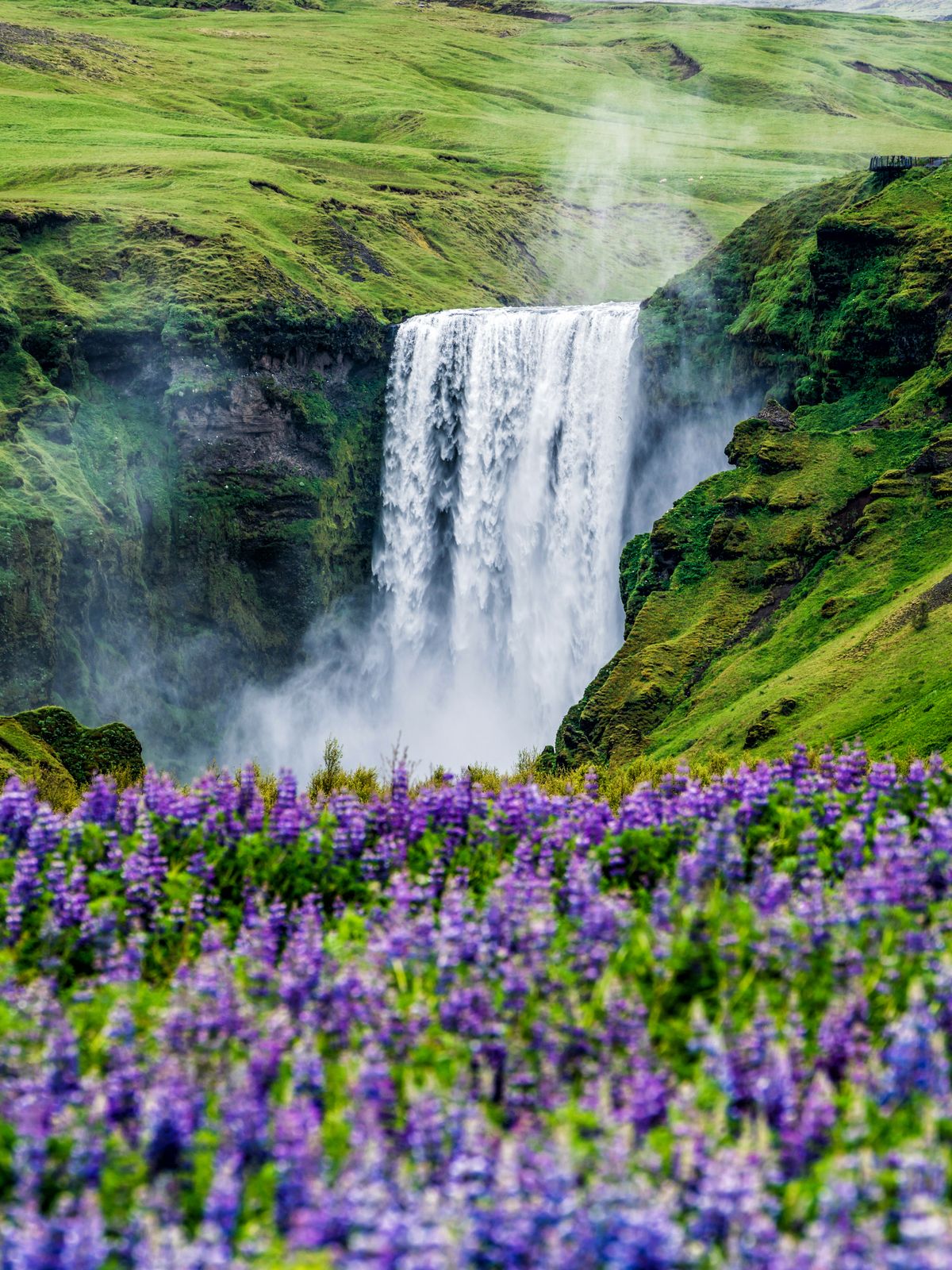
Nearby Skógafoss is also worth staying up for. The waterfall makes an excellent foreground for long-exposure shots.
Jökulsárlón Glacier Lagoon
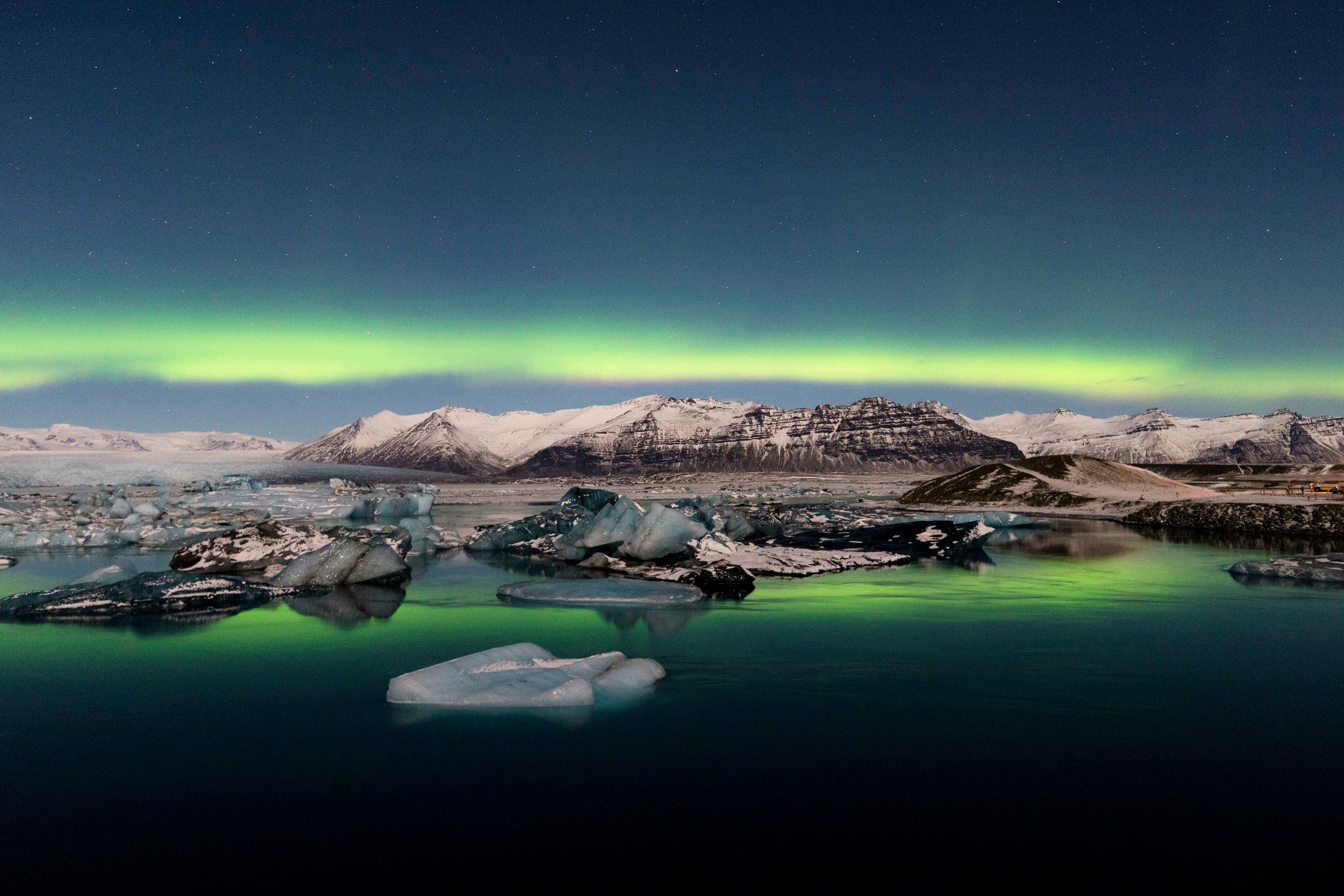
This is probably Iceland's best single aurora location. Icebergs from Vatnajökull glacier float through the lagoon, and on a clear night the aurora reflects off the water and the ice. Just across the Ring Road, Diamond Beach has chunks of glacier ice scattered across black sand, which makes for another great composition.
I'd book at least two nights near Jökulsárlón if you can. One night is often not enough because clouds move in, and a second chance makes a real difference.
Snæfellsnes Peninsula
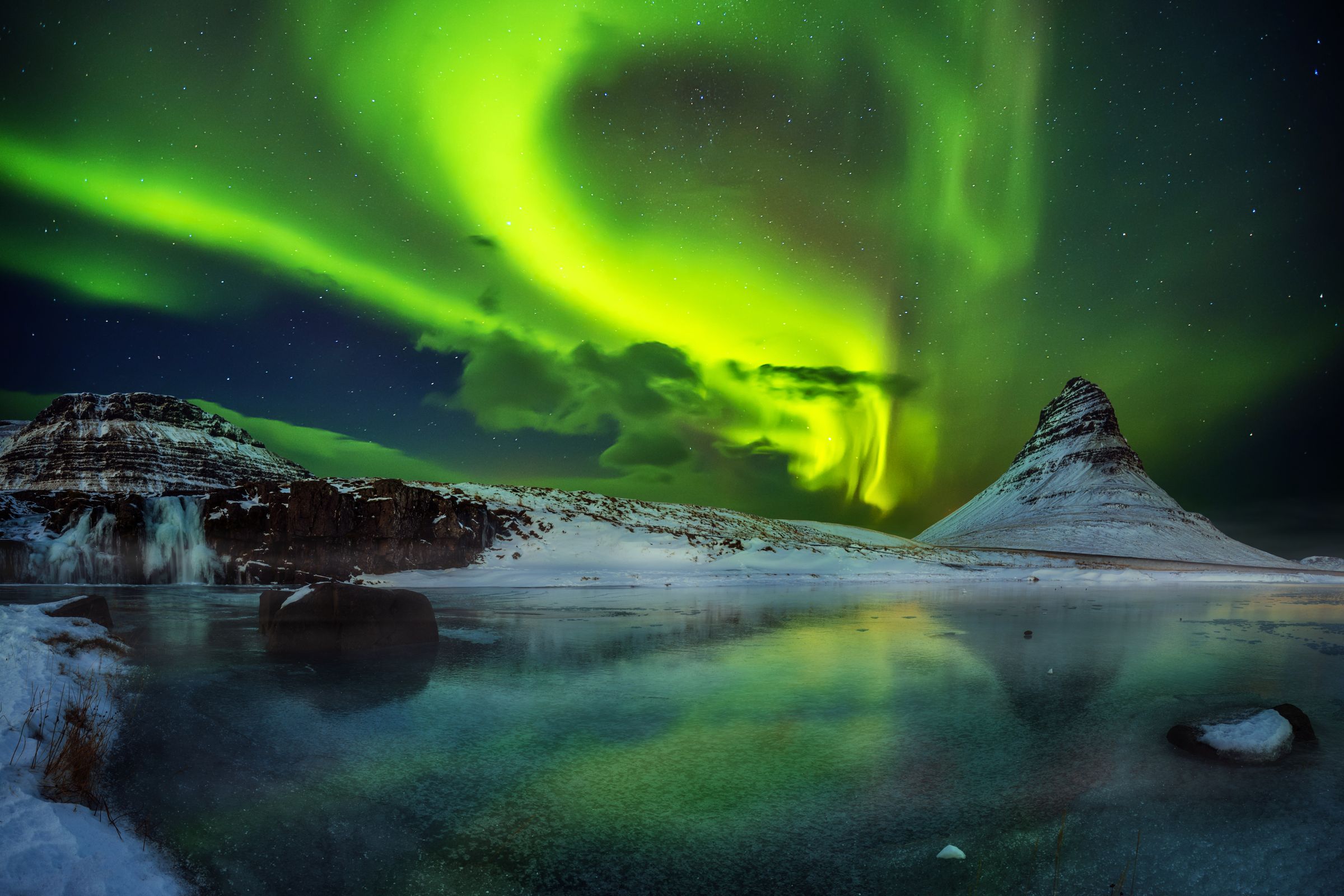
The Snæfellsnes Peninsula is often described as Iceland in miniature, and it's fair. Glaciers, lava fields, sea cliffs, fishing villages; all in one drive. Kirkjufell mountain is the most photographed aurora spot in Iceland, and that distinctive shape with the waterfalls in front of it is iconic.
It's also busy. If you want something quieter, the black church at Búðir (Búðakirkja) is darker, more atmospheric, and has fewer other photographers in your shot. That's where I'd go.
Akureyri & North Iceland
Akureyri is Iceland's second city and a good base for exploring the north. Lake Mývatn nearby has dark skies, geothermal landscapes, and volcanic formations that work well as aurora foregrounds. North Iceland can also have clearer weather than the South Coast during certain stretches, which is worth factoring in when you're chasing gaps.

Westfjords
The Westfjords have some of the lowest light pollution in Iceland, and the scenery is dramatic. The trade-off is access: winter roads can close, services are limited, and conditions are unpredictable. This one is for travelers who have experience with winter driving and a flexible itinerary.

Section Recap
| Location | Dark Skies | Best For | Watch Out For |
| Reykjavík (Grótta) | Low | No-car travelers, first night attempt | Light pollution limits faint auroras |
| Reykjanes Peninsula | Moderate | Quick dark-sky escape from the city | Still relatively close to urban areas |
| Þingvellir National Park | Good | Golden Circle trips, easy access | Can be busy with tour groups |
| Vík & Reynisfjara | Very good | Black sand beach photography | Dangerous sneaker waves at Reynisfjara |
| Jökulsárlón Glacier Lagoon | Excellent | Photography, reflections, icebergs | Book 2 nights to improve odds |
| Snæfellsnes Peninsula | Very good | Kirkjufell shots, fewer crowds overall | Kirkjufell itself gets crowded |
| Akureyri & Lake Mývatn | Excellent | Northern base, geothermal landscapes | Requires a longer trip or a domestic flight |
| Westfjords | Excellent | Remote, ultra-dark sky viewing | Difficult winter road access |
Northern Lights Tours vs Self-Drive
This is the decision most people spend the most time on. Here's a straightforward way to think about it.
Guided Tours
Tours make sense if you're not comfortable driving on icy roads, you're based in Reykjavík, or you'd rather have someone else track the forecast and figure out where to go.
The main types:
- Bus tours: The most affordable option, easy to book, good for first-timers. Groups can be large, and you're on the guide's schedule.
- Small-group and Super Jeep tours: More expensive but worth it for the flexibility. Super Jeeps can access rougher terrain and reach darker spots farther from the city.
- Boat tours: You go out onto Faxaflói Bay, completely away from city lights. Weather and sea conditions affect availability.
- Photography tours: Designed for people with DSLR or mirrorless cameras. Includes tripod stops and guidance on settings and composition.
Check whether the tour offers free rebooking if no aurora appears. Reputable operators usually do, and it takes a lot of pressure off.
Self-Drive Aurora Hunting
A rental campervan (or car) is the better option if you want flexibility. You can chase cloud gaps, stay out as long as you want, and stop wherever you find a good spot. For photographers especially, this is the way to go.
That said, driving in winter in Iceland is not to be taken lightly. Black ice, high winds, and sudden whiteouts are real risks. I'd recommend checking road.is before every drive, keeping your fuel above half a tank, and only stopping in designated pull-offs, never in the middle of the road.
Iceland Aurora Forecast Explained
Most people focus too much on the Kp index and not enough on cloud cover. Getting this the right way around makes a big difference.
How To Read the Icelandic Met Office Forecast
The Icelandic Meteorological Office aurora map is the tool to bookmark. It shows cloud cover across Iceland (green = cloudy, white = clearer skies) alongside an auroral activity rating from 0–9. Check it every few hours in the evening. The forecast shifts significantly and it's worth staying on top of it.
The Kp Index Explained
The Kp index measures global geomagnetic disturbance on a scale of 0–9. NOAA issues storm watches when predicted values hit Kp 5 or above.
For Iceland, you don't need a high number to see something real:
| Kp | What It Means for Iceland |
| 0–1 | Weak activity; faint aurora possible in very dark remote areas |
| 2–3 | Good chance under clear, dark skies |
| 4 | Strong display likely if skies cooperate |
| 5+ | Geomagnetic storm; potentially a great show |
| 6-9 | Could be intense, but clouds still decide everything |
Forecast Mistakes Most Travelers Make
A few specific errors come up constantly:
- Holding out for Kp 5: In Iceland, Kp 2–3 under a clear sky is enough for a real display. You don't need a storm.
- Ignoring clouds: This is the big one. A Kp 8 event behind thick overcast is completely invisible.
- Giving up too early: Auroras pulse. A faint arc at 10 PM can turn into a full-sky display by midnight.
- Staying put: Driving 60–90 km can put you under clear skies when your current location is socked in.
Photography Tips
You don't need professional gear, but a few basics separate good aurora photos from blurry green blobs.
Camera Settings
You need to shoot in manual mode. Auto settings can't handle this. Use these as a starting point and adjust from there:
Essential Gear
The gear that actually matters:
- Tripod: Non-negotiable. Iceland is windy. Get a sturdy one.
- Wide-angle lens: 14–24mm works well. Faster aperture (f/1.4–f/2.8) means you can use lower ISO and get cleaner images.
- Spare batteries: Cold kills battery life fast. Keep at least one backup warm in your pocket.
- Lens cloth: Frost and sea spray will hit your lens at some point.
- Headlamp with red mode: Red light keeps your night vision intact.
Smartphone Photography
Modern phones can capture auroras well enough for social media, especially with night mode or a long-exposure app. The key is stabilization. Handholding at 5–10 seconds gives you blur. Use a small tripod or prop your phone against something solid.
Phones are fine for sharing the experience. They won't match a mirrorless camera with a fast lens, particularly for faint or fast-moving displays.
Composition Tips
A featureless green sky is a missed shot. The best aurora photos in Iceland almost always have a strong foreground. Good options:
- Glacier lagoon with floating icebergs (Jökulsárlón)
- Waterfalls (Skógafoss, Seljalandsfoss)
- Mountain profiles (Kirkjufell, Vestrahorn)
- Wave-washed glacier ice on black sand (Diamond Beach)
- Empty roads cutting through lava fields
Start by facing north, but during an active display, keep checking the whole sky. Strong auroras can appear in every direction.
Conclusion
Seeing the Northern Lights in Iceland comes down to one thing: put yourself under clear, dark skies when there's geomagnetic activity, and be patient. The location matters, the forecast matters, the preparation matters — but flexibility matters most of all.
Iceland's mix of accessible wilderness, solid forecasting tools, and dramatic scenery makes it one of the more practical aurora destinations out there. It's not about luck. It's about being ready.
If I were doing this trip, I'd book at least 6–7 nights, stay in rural accommodation with open views to the north, rent a car if winter driving doesn't stress me out, and check the Icelandic Met Office forecast every single evening before deciding where to go.
FAQs about the Northern Lights in Iceland